
Searching for the countertop company that will actually deliver a slab you love, on a schedule you can live with, is one of the most important decisions in any kitchen or bathroom remodel. San Diego has no shortage of fabricators and showrooms, but the difference between a smooth project and a stressful one almost always comes down to who you hire, not which material you pick.
This guide breaks down exactly what separates a reputable countertop company from a risky one, what questions to ask before signing a contract, and how the fabrication process should actually unfold from template to install.
What Makes a Countertop Company Trustworthy
Not every business that sells slabs actually fabricates and installs them. Some are brokers who outsource the cutting and polishing to a third-party shop you never meet, which makes it harder to hold anyone accountable if a seam or edge comes out wrong. When you are evaluating the countertop company for your project, ask directly whether templating, fabrication, and installation all happen in-house or under their direct supervision.
Licensing and Insurance
A legitimate countertop company should be able to show proof of general liability insurance and, depending on scope, a contractors license. This protects you if a slab is damaged during install or if a worker is injured in your home. Never take verbal assurances at face value; ask for documentation before signing anything.
Key fact: Templating happens only after cabinets are fully installed, using a laser or digital template, and the typical fabrication-to-install turnaround runs about 1-3 weeks from that point.
Questions to Ask Before You Sign a Contract
A short conversation up front can save weeks of frustration later. Reputable companies expect these questions and answer them without hesitation.
- Do you fabricate on-site or send slabs to a third-party shop?
- Can I see and approve the exact slab, not just a sample chip, before cutting?
- What is your typical turnaround from template to install?
- Who is responsible for removing and disposing of the old countertop?
- What happens if a slab is chipped or cracked during fabrication or transport?
- Is there a written warranty on materials and workmanship, and for how long?
Understanding the Materials Before You Compare Quotes
You cannot fairly compare bids from different companies unless everyone is quoting the same material, thickness, and edge profile. Quartz, an engineered stone, is resin-bound, non-porous, and never needs sealing, with a Mohs hardness around 7 and installed costs typically running fifty to one hundred twenty dollars per square foot. Granite, a natural stone, is porous and needs resealing roughly every one to two years, runs forty to one hundred dollars per square foot installed, and is naturally heat resistant with unique veining on every slab.
Do Not Confuse Quartz and Quartzite
Quartzite is a natural stone that is often confused with engineered quartz because the names sound alike, but the two materials behave very differently. Quartzite is very hard, Mohs 7, and heat resistant, but it IS porous and DOES require sealing like granite, unlike engineered quartz which never needs sealing. A knowledgeable countertop company will explain this distinction clearly instead of letting you assume quartz and quartzite are interchangeable, since mixing them up leads to real maintenance surprises down the road.
Marble, meanwhile, is porous and soft, Mohs 3 to 4, and etches from acidic foods like lemon, vinegar, and wine even when sealed, so it needs more frequent resealing than granite despite being prized for its classic veining. Marble installed costs typically run sixty to one hundred fifty dollars per square foot, while quartzite runs seventy to one hundred fifty dollars per square foot.
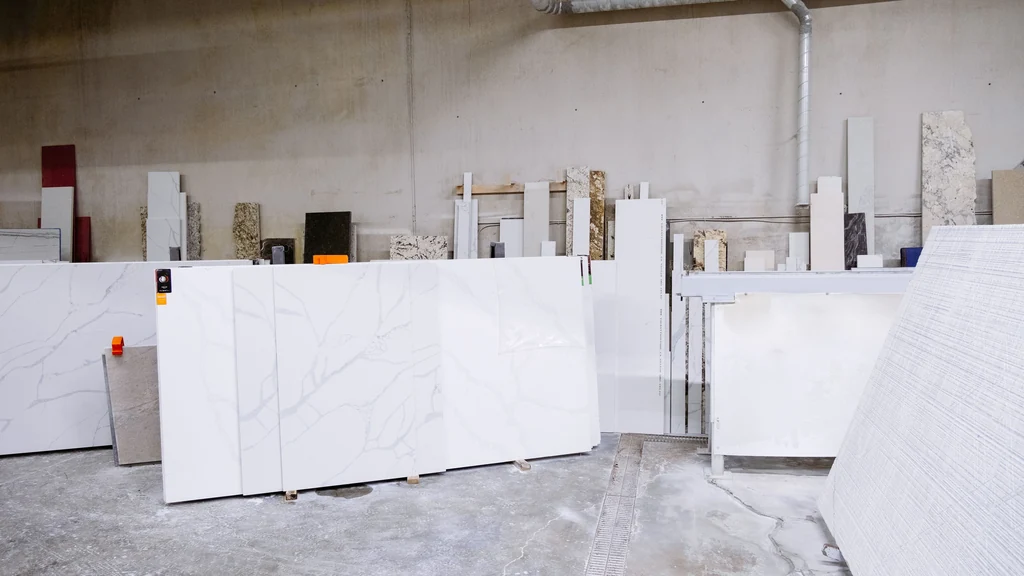
Pro tip: Ask to see the actual slab your countertop will be cut from, not just a small sample chip. Natural stone varies dramatically piece to piece, and a company confident in its inventory will happily walk you through the slab yard.
What Fabrication and Installation Should Actually Look Like
Once cabinets are set, a professional crew templates the space using laser or digital tools to capture exact dimensions, including cutouts for sinks, cooktops, and outlets. Standard slab thickness options are two centimeters, which requires a plywood substrate and edge buildup, or three centimeters, which is self-supporting and the most common choice for US residential kitchens.
Overhangs and Seams
If you are planning a kitchen island with unsupported overhang, know that spans beyond roughly ten to twelve inches typically need corbels or steel support brackets, though the exact limit depends on the material and your fabricators engineering specs. Seams are generally unavoidable on larger islands or long runs since most slabs top out around nine to ten feet in length, so ask your countertop company where they plan to place seams and why, since it is a real design decision and not just a fabrication detail.
Edge profiles are another area where the right company will guide you rather than upsell you. Eased, bullnose, ogee, and mitered waterfall edges, where the slab wraps down to the floor, are the most requested styles, and each has a different labor cost and visual weight.
San Diego-Specific Considerations
San Diegos mild climate makes outdoor kitchens popular year-round, but material choice matters more outside than in. Quartzs resin binder can UV-fade or discolor outdoors over time, so granite, quartzite, and porcelain slab are the more climate-appropriate choices for exterior installations here. A countertop company with real San Diego installation experience should bring this up proactively rather than selling you an indoor-rated material for a patio kitchen.
Porcelain slab is a newer category worth asking about if you are building an outdoor kitchen: it is extremely hard, UV and heat resistant, and typically thin at twelve to thirteen millimeters, making it a strong choice for exterior applications where quartz falls short.
Key fact: Quartz is NOT fully heatproof despite marketing claims, since the resin binder can discolor or crack under direct hot cookware, so trivets are still recommended even with an engineered stone countertop.
Budgeting Realistically
Laminate remains the most budget-friendly option at roughly twenty to fifty dollars per square foot installed, but it is not heat or scratch resistant and cannot be repaired or refinished once damaged. If budget is the primary concern, ask the countertop company whether laminate makes sense for your specific use case, or whether a mid-range granite might offer better long-term value for only a modest increase in cost.
Get every quote broken down by material cost, fabrication, and installation labor separately. A company that only gives you a single lump-sum number without itemization makes it much harder to compare apples to apples against a competing bid.
Red Flags to Watch For
- Pressure to sign same-day without time to see the actual slab
- No written contract specifying material, thickness, edge profile, and timeline
- Large upfront deposits, more than fifty percent, before templating has even occurred
- No physical showroom or slab yard you can visit
- Vague answers about who performs the actual fabrication
Checking Reviews and Reputation the Right Way
Online reviews are useful, but only if you read them critically. A handful of five-star reviews with no detail tell you little; look instead for reviews that mention specific projects, specific materials, and how the company handled a problem when one came up, since every fabricator eventually deals with a chipped edge or a shipping delay. How a countertop company responds to a bad review, or to a customer complaint, often tells you more than the star rating itself.
Ask for two or three recent local references you can actually call, not just a portfolio of photos. A company that has installed dozens of kitchens in San Diego neighborhoods should be able to connect you with real homeowners willing to talk about their experience, including how accurate the original quote turned out to be once the job was finished.
How the Project Timeline Typically Unfolds
Understanding the realistic sequence of events helps you plan the rest of your remodel around your countertop installation instead of being surprised by delays. The process generally moves through five stages: material selection and slab approval, cabinet installation, templating, fabrication, and finally installation.
Material selection can take anywhere from a single showroom visit to several weeks if you are sourcing an imported natural stone slab. Once your cabinets are fully set and level, the countertop company sends a technician to template the space, capturing every cutout and edge with a laser or digital scanner so the slab is cut to an exact fit rather than an approximation.
From templating, fabrication typically takes one to three weeks depending on the material, the complexity of cutouts, and the fabricators current workload. Installation itself is usually completed in a single day for a standard kitchen, though large islands with waterfall edges or multiple seams can take longer. Plumbing reconnection for sinks and faucets is often handled the same day or the following day, so ask upfront whether that is included in your quote or billed separately.
Residential Versus Commercial Countertop Needs
Not every countertop company that handles residential kitchens is equipped for commercial work, and the reverse is also true. Commercial applications, such as restaurant prep counters or retail checkout surfaces, often demand different durability standards, faster turnaround to minimize business downtime, and compliance with health code requirements that a residential-focused fabricator may not be familiar with.
If your project is commercial, ask specifically about the companys experience with similar commercial installations, their ability to work around a business operating schedule, and whether they can meet any health department requirements specific to your industry. A company that primarily does home kitchens may still do good work, but you want to confirm they understand the different demands before committing.
Warranty and Long-Term Support
A written warranty should cover both the material itself and the labor of installation, and the two are not always the same length. Many manufacturers back engineered quartz with a ten-to-fifteen-year material warranty, but the installing companys own workmanship warranty, covering things like seam alignment and caulking, is often shorter and set entirely by that individual business. Ask for the workmanship warranty in writing and confirm what voids it, such as installing a sink or appliance yourself after the countertop is in.
Also ask what happens after the sale if something goes wrong months or years later. A countertop company that stands behind its work will have a clear process for warranty claims rather than directing you to call the manufacturer and figure it out on your own.
Making Your Final Decision
Choosing the countertop company for your San Diego remodel comes down to transparency: can they show you the actual slab, explain their fabrication process in plain terms, back their work with a real warranty, and give you a realistic timeline from template to install. Take the time to compare at least two or three quotes, ask the questions above, and prioritize companies who explain trade-offs like quartz versus quartzite or indoor versus outdoor material choices rather than just pushing whatever is easiest for them to sell. A little diligence up front is what turns a countertop project into a surface you will enjoy for decades instead of a source of regret.