
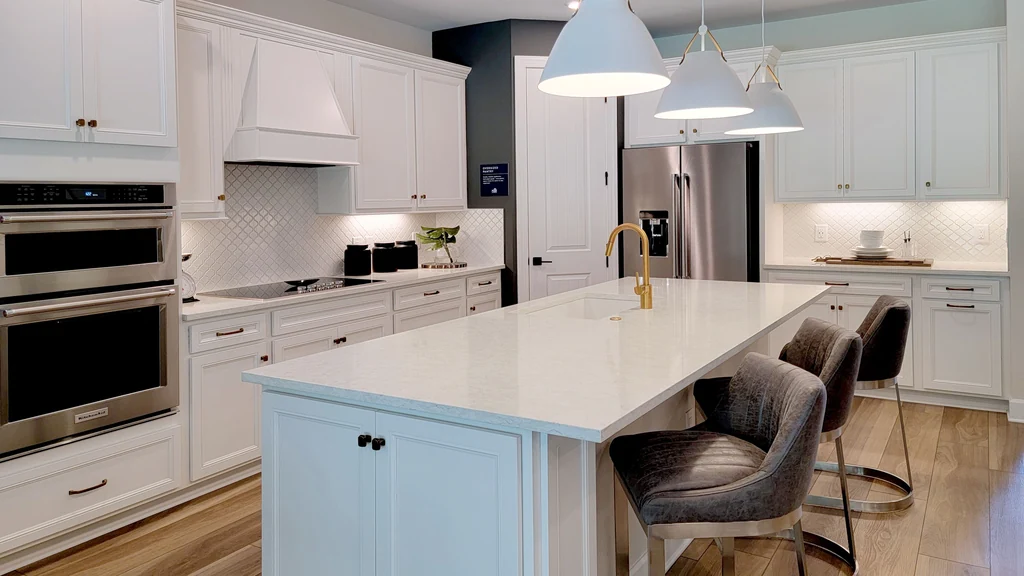
If you're weighing quartz countertops in San Diego for a kitchen remodel, you're looking at the single most popular countertop material in Southern California right now, and for good reason. Quartz combines a durable, low-maintenance surface with a huge range of colors and patterns, which makes it an easy sell for homeowners from North Park bungalows to new-build kitchens in Carmel Valley.
But quartz gets thrown around loosely in showrooms, and it's often confused with natural stone options like quartzite or granite. Before you sign a contract with a San Diego fabricator, it helps to understand exactly what quartz is, what it costs installed, where it shines, and where it genuinely falls short, especially for our coastal and inland climate.
What Quartz Countertops Actually Are
Engineered quartz is not a solid slab of natural quartz stone. It's a manufactured surface, roughly 90-94% ground quartz mineral bound together with polyester resins and pigments, pressed and cured into slabs. That engineering is exactly what makes quartz behave so differently from the natural stones it sits next to in a showroom.
Key fact: Quartz is a resin-bound, non-porous engineered stone that never needs sealing, offers the most consistent pattern and color of any countertop material, and rates roughly 7 on the Mohs hardness scale.
That non-porous surface is the headline benefit. Because there's no stone porosity for liquids to soak into, quartz resists staining from coffee, wine, and cooking oils without any sealing maintenance, ever. That's a real advantage over natural stone, and it's the main reason quartz has taken over so much of the San Diego remodeling market over the last decade.
Quartz vs. Quartzite: Don't Confuse Them
One of the most common mix-ups we see in San Diego kitchen consultations is homeowners assuming quartz and quartzite are the same material with different spellings. They are not. Quartzite is a natural metamorphic stone, quarried in slabs like granite or marble, and it behaves like natural stone in every practical sense: it's porous and requires sealing, even though it's extremely hard and heat resistant. Quartz, on the other hand, is manufactured and never needs sealing. If a salesperson can't clearly explain that difference to you, get a second opinion before you buy.
What Quartz Countertops Cost Installed in San Diego
Countertop pricing is always quoted as materials plus fabrication plus installation, and San Diego labor rates tend to run at or slightly above national averages given the local cost of living.
Key fact: Typical installed cost for quartz runs $50-$120 per square foot, compared to $40-$100 for granite, $60-$150 for marble, and $20-$50 for laminate.
Where your quote lands in that quartz range depends heavily on the slab tier you choose. Entry-level solid-color quartz sits at the low end, while premium veined designs meant to mimic Calacatta marble push toward the top. Edge profile complexity, the number of seams your layout requires, and whether you're adding a waterfall edge on an island all move the number too.
Slab Thickness and What It Means for Your Budget
Most San Diego kitchens today use 3cm (roughly 1 1/4 inch) quartz, which is thick enough to be self-supporting without extra plywood buildup underneath. The thinner 2cm option is available and costs somewhat less in raw material, but it requires a plywood substrate and edge lamination to look and feel substantial, which can eat into any savings once fabrication labor is factored in. For most residential kitchens, 3cm remains the standard choice for a reason.
Design Details: Edges, Overhangs, and Seams
Once you've picked a slab color, the fabrication details are where a countertop really gets personalized, and where a good local fabricator earns their fee.
Edge Profiles
The four most requested edge styles in San Diego kitchens are eased (a simple softened square edge), bullnose (fully rounded), ogee (a decorative S-curve popular in more traditional kitchens), and the mitered waterfall edge, where the slab wraps continuously down the side of an island to the floor. Waterfall edges have become especially popular in newer San Diego builds and modern remodels because they showcase the slab's veining as a design feature rather than hiding it under cabinetry.
Island Overhangs Need Support
Pro tip: If you're planning bar seating on a quartz island, ask your fabricator about support early. Overhangs beyond roughly 10-12 inches unsupported typically need corbels or steel brackets underneath, and the exact limit depends on the material and your fabricator's engineering specs, not just what looks good in a showroom photo.
Skipping this step is one of the most common and preventable mistakes in DIY-adjacent kitchen projects. An unsupported overhang can crack under weight over time, and that's a repair, not a warranty claim, in most cases.
Seams Are a Design Decision, Not a Flaw
Quartz slabs typically top out around 9-10 feet in length, so seams are generally unavoidable on larger kitchen islands or long runs of counter. A good fabricator will walk you through where seams will fall before templating locks in the layout, so you can decide whether a seam near the sink or tucked at the edge of the island works better for your specific kitchen. This is worth discussing at the estimate stage, not discovering on install day.
The Installation Timeline: What to Expect
One thing that surprises first-time remodelers in San Diego is that countertop templating doesn't happen until your cabinets are physically installed and level.
Key fact: Templating happens after cabinets are installed, typically with a laser or digital scan, and the typical fabrication-to-install turnaround afterward is 1-3 weeks.
That means your countertop timeline is downstream of your cabinet installation, not parallel to it. If your general contractor or kitchen designer promises a faster turnaround than that, it's worth asking exactly how they're compressing the fabrication schedule. Rushed fabrication is where seam quality and edge polish problems tend to show up.
Living With Quartz: Care, Heat, and the San Diego Climate Question
Quartz earns its reputation as the low-maintenance choice, but low-maintenance doesn't mean indestructible, and this is where a lot of marketing oversells the material.
Heat Resistance Has Limits
Pro tip: Quartz is not fully heatproof despite how it's often marketed. The resin binder that holds the stone particles together can discolor or even crack under direct contact with hot cookware straight off the stove, so keep trivets and hot pads in regular rotation even on a quartz counter.
This matters more than most homeowners expect, because the whole pitch of quartz is durability, and a scorch mark from a cast iron pan is a real, permanent risk if you treat the surface as bulletproof.
Outdoor Kitchens: Where Quartz Isn't the Right Fit
San Diego's indoor-outdoor living culture means outdoor kitchens come up constantly in local consultations, and this is one spot where we steer homeowners away from quartz specifically because of our climate.
Key fact: In San Diego outdoor kitchens, quartz's resin binder can UV-fade or discolor over time from sustained sun exposure, making granite, quartzite, and porcelain slab the more climate-appropriate choices for exterior installations here.
If your project includes a patio kitchen or outdoor bar in addition to your indoor kitchen, plan on a different material for that exterior space, even if you love your quartz indoors. A fabricator who tries to sell you the same quartz slab for both spaces without mentioning UV exposure isn't giving you the full picture.
How Quartz Compares to Other San Diego Countertop Options
Quartz isn't automatically the right answer for every kitchen, so it's worth understanding how it stacks up against the natural stone alternatives San Diego fabricators work with most.
- Granite: Porous natural stone that needs resealing roughly every 1-2 years, rates 6-7 on the Mohs scale, and is naturally heat resistant with unique veining on every slab, no two are identical.
- Marble: Porous and notably softer (Mohs 3-4), etches from acidic foods like lemon juice or wine even when properly sealed, and needs more frequent resealing than granite, but remains the go-to for classic, high-end veining.
- Quartzite: Very hard (Mohs 7) and heat resistant like quartz, but it IS porous and DOES require sealing, unlike engineered quartz. It's a natural stone with quartz-like durability but granite-like maintenance needs.
- Porcelain slab: A newer category, extremely hard and UV/heat resistant, typically 12-13mm thin, and a strong choice specifically for the outdoor kitchens where quartz struggles in our sun.
For a straightforward interior kitchen with heavy daily use and zero interest in sealing maintenance, quartz remains the practical default for most San Diego homeowners. It's only when you introduce direct sun exposure, extreme heat habits, or a preference for one-of-a-kind natural veining that the other materials start to make more sense.
Popular Quartz Colors and Design Trends in San Diego Kitchens
San Diego's design palette leans coastal and light-filled, and that shows up clearly in which quartz colors move fastest in local showrooms. Bright white quartz with soft gray veining, meant to echo Carrara or Calacatta marble, remains the top seller across new construction and remodels alike, largely because it pairs easily with both the warm wood cabinetry common in coastal homes and the more matte, modern cabinet lines showing up in newer builds around Little Italy and East Village condos.
Warmer greige and taupe quartz tones have also picked up momentum in inland San Diego neighborhoods like Rancho Bernardo and Poway, where kitchens tend to run larger and homeowners are pairing quartz with mixed-metal fixtures rather than the all-white, all-brass look popular a few years ago. Solid, near-black quartz shows up more selectively, usually on a waterfall island paired with lighter perimeter counters, a two-tone approach that reads as more custom than a single slab color throughout.
Pro tip: Bring your actual cabinet door and flooring samples to the slab yard rather than relying on a small quartz sample chip. Quartz can shift noticeably in undertone under different lighting, and San Diego's strong natural light in particular can make a slab read warmer or cooler than it did on a 2-inch sample in a dim showroom.
Matte and honed finishes have also grown more common alongside the traditional polished look, giving quartz a softer, more stone-like appearance that some homeowners prefer for a less reflective countertop, particularly in kitchens with a lot of natural light bouncing off glossy surfaces already.
Choosing a Quartz Fabricator in San Diego
Because quartz fabrication and installation quality varies so much between shops, the estimate process itself tells you a lot about who you're hiring.
Ask any San Diego fabricator you're considering to walk through seam placement, overhang support, and edge profile options during the estimate, not after the contract is signed. A fabricator who brings up trivets and heat limits unprompted, rather than letting you assume the marketing claims are absolute, is generally a good sign they'll be straightforward about the rest of the project too. And always confirm the templating-to-install timeline in writing so you can plan the rest of your remodel around it realistically.
Summary: Is Quartz Right for Your San Diego Kitchen?
Quartz countertops remain the strongest all-around choice for most San Diego indoor kitchens: non-porous, sealing-free, consistent in color, and available in a design range that covers everything from solid modern colors to marble-look veining. The two things to plan for going in are realistic heat habits (trivets, always) and steering clear of quartz for any exposed outdoor kitchen space given our sun exposure.
If you're comparing quotes for quartz countertops in San Diego, use the details in this guide, thickness, edge profile, seam placement, and templating timeline, as your checklist for evaluating any estimate, not just the per-square-foot number on the page. You can also see how our quartz countertop installation in San Diego works, from templating to install day.