
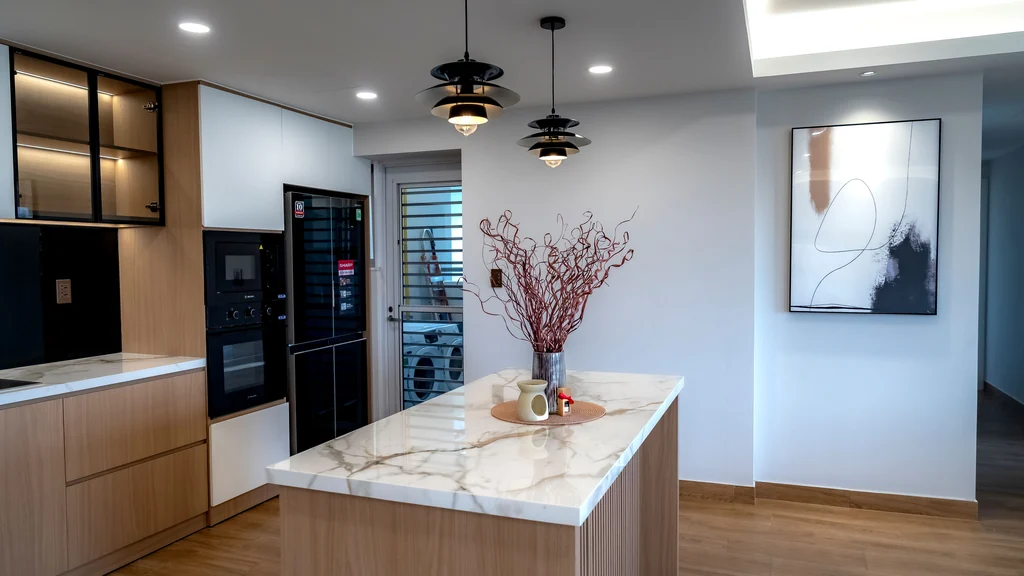
Choosing kitchen countertops in San Diego means weighing more than color and pattern. Between coastal humidity in neighborhoods like Pacific Beach, intense summer sun in inland communities like Santee, and the simple day-to-day reality of a busy kitchen, the material you pick has to perform, not just look good in a showroom. This guide walks through every major countertop material available to San Diego homeowners, what each one actually costs installed, and the details fabricators wish more clients understood before they sign a contract.
Whether you're renovating a mid-century kitchen in North Park or finishing new construction in Rancho Bernardo, the same core decisions apply: material, thickness, edge profile, and who does the fabrication and install. Get those right and you'll have a countertop that holds up for decades. Get them wrong and you're looking at premature sealing failures, cracked seams, or a color that fades in six months of Southern California sun.
Kitchen Countertop Materials: What San Diego Homeowners Actually Choose
There is no single "best" kitchen countertop material. The right choice depends on your budget, how the kitchen gets used, and how much maintenance you're willing to do. Here's how the major options stack up.
Quartz (Engineered Stone)
Quartz is resin-bound engineered stone, and it remains the most popular choice for San Diego kitchens for good reason: it's non-porous, never needs sealing, and offers the most consistent pattern and color of any surface on this list, with a Mohs hardness around 7. If you're weighing quartz specifically, our complete quartz countertops buyer's guide breaks down colors, brands, and edge options in more depth. One caveat worth knowing up front: quartz is not fully heatproof despite how it's often marketed. The resin binder can discolor or even crack under a hot pan set directly on it, so trivets are still a good habit even with quartz.
Granite
Granite is natural stone, quarried and cut rather than engineered, which means every slab has unique veining and no two kitchens look quite the same. It shares roughly the same hardness as quartz, Mohs 6-7, and it's naturally heat resistant. The tradeoff is porosity: granite needs resealing roughly every 1-2 years to keep it resistant to stains from oil, wine, and acidic foods.
Marble
Marble is prized for its classic veining, but it's genuinely a different material to live with than quartz or granite. It's soft, Mohs 3-4, and porous, and it will etch, meaning it develops dull, permanently visible marks, from acidic foods like lemon juice, vinegar, and wine, even when properly sealed. It also needs more frequent resealing than granite. Marble is a beautiful choice for a baking station or a bathroom vanity, but homeowners should go in with realistic expectations about how it ages in a working kitchen.
Quartzite
This is where a lot of confusion happens, and it's worth being precise: quartzite is a natural stone, not the same material as engineered quartz, despite the similar name. Quartzite is very hard, Mohs 7, and heat resistant, but unlike engineered quartz, it IS porous and DOES require sealing, more like granite. If a showroom is using "quartz" and "quartzite" interchangeably, ask which one you're actually looking at before you commit.
Porcelain Slab
Porcelain slab is a newer category on the residential market: extremely hard, UV resistant, and heat resistant, typically manufactured at 12-13mm thickness. Its UV stability makes it a strong choice for San Diego's many outdoor kitchens.
Soapstone, Butcher Block, and Laminate
Soapstone is naturally non-porous and very heat resistant, though it's softer and more prone to scratching, and it darkens attractively over time with periodic mineral oil treatment. Butcher block countertops need regular food-safe oiling, aren't heat resistant, but can be sanded and refinished when they get scratched or stained, a real advantage for a kitchen island that takes daily abuse. Laminate is the most budget-friendly option on this list, but it isn't heat or scratch resistant and can't be repaired or refinished once it's damaged, so it's really a first-kitchen or rental-property material rather than a forever choice.
Key fact: Quartzite is often mistaken for engineered quartz because of the name, but quartzite is a porous natural stone that needs sealing, while engineered quartz is non-porous and never needs it. Confirm which one you're buying before it's on your countertop.
What Kitchen Countertops Cost in San Diego
Installed pricing, meaning materials, fabrication, and installation combined, varies widely by material. As a general range: laminate runs $20-$50 per square foot, granite $40-$100 per square foot, quartz $50-$120 per square foot, marble $60-$150 per square foot, quartzite $70-$150 per square foot, and porcelain slab $60-$120 per square foot. Where your project lands in each range depends on the specific slab you choose, edge profile, and how much cutting and seaming the layout requires.
Most San Diego kitchens end up somewhere in the quartz or granite range, since both offer a strong balance of durability and cost. Marble and quartzite tend to get reserved for islands, accent areas, or kitchens where the homeowner has specifically fallen in love with the veining and is willing to pay for it.
Thickness, Edges, and Seams: The Details That Actually Matter
Once you've picked a material, three technical details shape both the look and the durability of the finished countertop.
Slab Thickness
Standard slab thickness comes in two options: 2cm (3/4 inch), which requires a plywood substrate underneath and edge buildup to look substantial, and 3cm (1 1/4 inch), which is self-supporting and is the most common choice in US residential kitchens. Thicker slabs cost more but eliminate the need for built-up edges.
Overhangs and Support
If you're planning a kitchen island with bar seating, overhang support matters. Overhangs beyond roughly 10-12 inches unsupported typically need corbels or steel support brackets underneath. The exact limit depends on the material and your fabricator's engineering specs, so this is a conversation to have before the layout is finalized, not after the slab is cut.
Edge Profiles
The most requested edge styles are eased, bullnose, ogee, and mitered waterfall edges, where the slab wraps down the side of the cabinet to the floor for a dramatic, seamless look. Waterfall edges use significantly more material and labor, so they add noticeably to the total cost.
Seams
Seams are generally unavoidable on larger kitchen islands and long runs, since most slabs top out around 9-10 feet in length. A good fabricator will walk you through where seams will fall before fabrication starts. Seam placement is a real design decision, not just a technical afterthought, so ask to see the layout drawing before it's cut.
Pro tip: Ask your fabricator to mark seam locations directly on your cabinet layout or template before fabrication. It's much easier to shift a seam a few inches during planning than to live with an awkwardly placed one for the next twenty years.
Sealing and Long-Term Maintenance
Maintenance requirements vary enormously by material, and this is often the deciding factor for busy households. Quartz and porcelain slab never need sealing. Soapstone is naturally non-porous but benefits from periodic mineral oil for appearance. Granite needs resealing roughly every 1-2 years. Marble and quartzite both require sealing and, in marble's case, more frequent resealing than granite due to its higher porosity and softness. Butcher block needs regular food-safe oiling to stay protected from water and stains.
Skipping sealing on a porous stone doesn't just risk stains, it can shorten the life of the surface. A simple annual test: if water sprinkled on the surface stops beading up and starts soaking in within a few minutes, it's time to reseal.
San Diego-Specific Considerations for Kitchen and Outdoor Countertops
San Diego's climate creates a few decisions that don't come up the same way in other markets. For outdoor kitchens, which are common in backyards across communities like Poway and Carlsbad, quartz's resin binder can UV-fade or discolor over time with sustained sun exposure. Granite, quartzite, and porcelain slab are the more climate-appropriate choices for exterior installations here, since they hold up to direct sun without the same fading risk. Indoors, San Diego's relatively mild, dry climate is gentle on most countertop materials compared to more humid regions, but coastal homes still benefit from the added stain protection that consistent sealing provides on porous stones.
Hiring a Fabricator and What to Expect During Installation
Templating, the step where your fabricator creates a precise digital or laser template of your cabinets, happens after cabinets are installed, not before. From templating to finished installation, typical turnaround is 1-3 weeks, depending on the fabricator's schedule and whether your slab is in stock or needs to be special-ordered. When comparing quotes, ask each fabricator to specify: slab thickness, edge profile, expected seam locations, overhang support method if you have an island, and whether sealing is included in the price for porous materials. A quote that's missing any of these details is hard to compare apples-to-apples against a more detailed one. See the materials we cut in our own shop for kitchen countertop installation in San Diego.
Key fact: Templating can only happen after your cabinets are installed and level, since the fabricator needs the exact final dimensions. Trying to rush this step before cabinets are set is one of the most common causes of fabrication delays.
Common Mistakes to Avoid When Choosing Kitchen Countertops
A few mistakes come up again and again in San Diego kitchen renovations, and most of them are avoidable with a little planning. The first is ordering a slab based purely on a small sample chip. Natural stone especially, granite, marble, and quartzite, varies significantly slab to slab, so always ask to see the actual slab your project will be cut from, or at minimum photos of it, before it's finalized.
The second common mistake is underestimating edge and cutout costs. Sink cutouts, cooktop cutouts, and upgraded edge profiles like waterfall edges are usually priced separately from the base per-square-foot rate, and they can add hundreds of dollars to a project that looked affordable on paper. Ask for an itemized quote rather than a single lump-sum number.
The third mistake is choosing a material without considering how the kitchen actually gets used. A household that cooks daily with acidic ingredients, tomatoes, citrus, wine, will be happier long-term with quartz or a sealed granite than with an unsealed or poorly maintained marble, no matter how much the veining photographs well online. And for households remodeling both a kitchen and an outdoor entertaining space, remember that the material that performs best indoors, quartz, is not necessarily the one that should go outside.
Choosing the Right Kitchen Countertop for Your San Diego Home
There's no universal answer to which kitchen countertops are right for a San Diego home, but there is a clear framework: if low maintenance and consistent appearance matter most, quartz is hard to beat indoors. If you want the character of natural stone and don't mind resealing every year or two, granite is the workhorse choice. If you're set on dramatic veining and can treat the surface carefully, marble delivers a look nothing else matches. And if the countertop is going outdoors, skip quartz and lean toward granite, quartzite, or porcelain slab instead.
Whatever material you land on, get clear answers on thickness, edge profile, seam placement, and sealing requirements before fabrication begins. A little planning up front is what separates a kitchen countertop that still looks great in fifteen years from one that's already showing its age after five.