
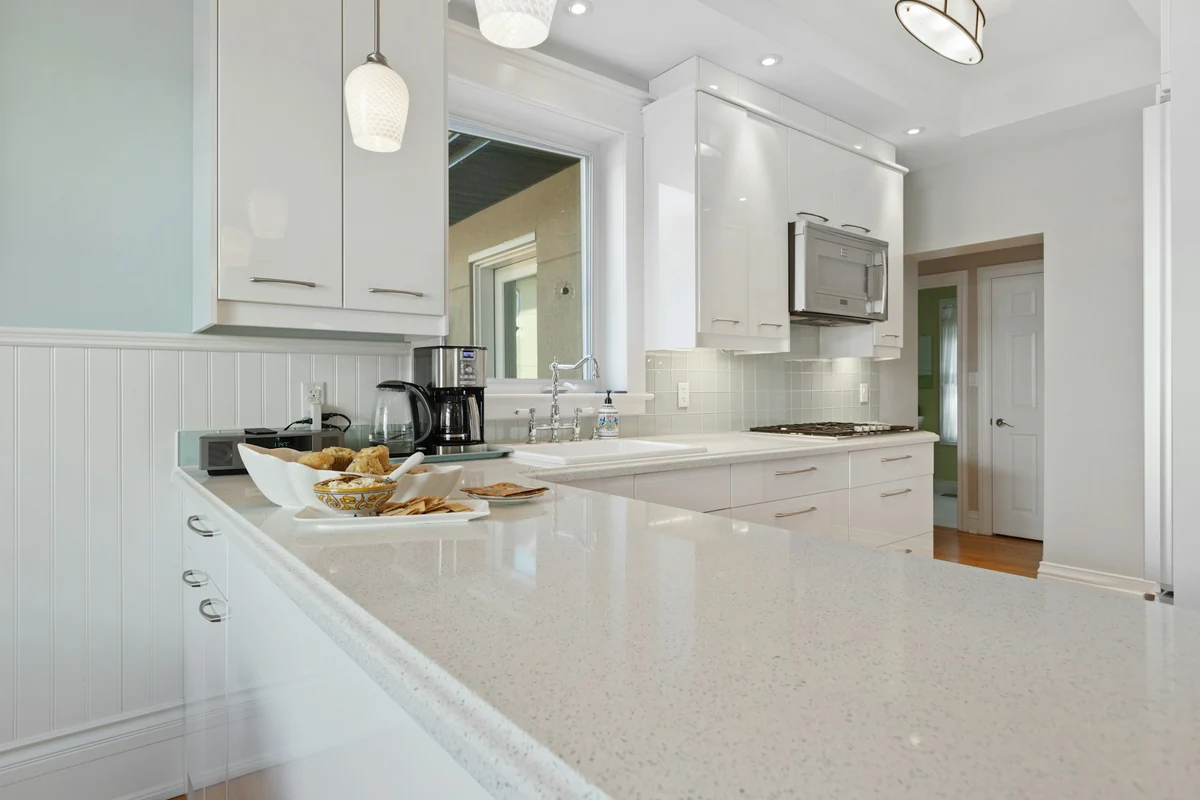
If you are shopping for quartzite slabs in San Diego, you are probably drawn to the look: soft whites, warm grays, and veining that runs deep through the stone rather than sitting on the surface. Quartzite delivers that look, and it is also one of the hardest natural stones you can put in a kitchen. It is also one of the most misunderstood, because the name sounds almost identical to quartz and the two behave very differently.
This guide walks through what quartzite actually is, how to confirm a slab is the real thing, what sealing and care involve, what it costs, and how to plan the buying and installation process so there are no surprises at the slab yard or on install day. It is written for homeowners in San Diego, Chula Vista, Carlsbad, Encinitas, La Jolla, and the rest of the county who want a straight answer before spending serious money.
What Quartzite Slabs Are (and What They Are Not)
Quartzite is a natural stone. It forms deep underground when quartz-rich sandstone is subjected to heat and pressure over a very long time, which fuses the grains into a dense, hard rock. Slabs are quarried, cut, and polished, and no two look exactly alike. Because the pattern runs through the full thickness of the stone, what you see on the showroom slab is what you get on the counter.
Engineered quartz is a different product altogether. It is made in a factory from ground quartz bound with resin and pigment, which makes it non-porous and very consistent from slab to slab. We cover that material in detail in our quartz countertops buyer's guide. The point to remember here is that quartz and quartzite are not interchangeable, and a salesperson who uses the words loosely is a red flag.
The practical differences at a glance
- Origin: quartzite is mined natural stone; quartz is manufactured with a resin binder.
- Porosity: quartzite is porous and does require sealing, much like granite. Engineered quartz does not.
- Hardness: quartzite is very hard, around Mohs 7, and some references put it slightly above that. Quartz also sits near 7.
- Heat: quartzite is naturally heat resistant. Quartz is not fully heatproof, because its resin binder can discolor or crack under direct hot cookware.
- Consistency: quartz is the most uniform option. Quartzite varies from slab to slab, which is part of its appeal.
Key fact: Quartzite is a natural stone that needs sealing, while engineered quartz is resin-bound and never needs sealing. Bob Vila's comparison of the two notes that the resin in quartz can be marked by hot pans, while quartzite tolerates hot cookware better.
Why Quartzite Slabs Make Sense for San Diego Homes
San Diego's mild climate means many kitchens open to patios, and plenty of homeowners cook outside year-round. That changes the material conversation. Quartz's resin binder can UV-fade or discolor outdoors over time, so for exterior installations granite, quartzite, and porcelain slab are the more climate-appropriate choices. If you are planning an outdoor kitchen in Encinitas, Carlsbad, or Rancho Santa Fe, quartzite belongs on the shortlist, though it will still need sealing like any other natural stone.
Indoors, quartzite appeals to people who love the look of marble but do not want the maintenance. Marble is soft (Mohs 3-4) and etches from lemon, vinegar, and wine even when sealed. A true quartzite gives you a similar light, veined appearance with far better hardness and resistance to acid etching. That is why it shows up so often in coastal homes in La Jolla, Del Mar, Coronado, and Point Loma, where bright, airy kitchens are the goal.
Heat and everyday cooking
Quartzite handles hot cookware better than engineered quartz. Even so, most fabricators still recommend trivets, since thermal shock and sealer wear are real concerns with any natural stone. Treat heat resistance as a safety margin rather than permission to drop a screaming-hot pan on the same spot every night.
Who should look elsewhere
If you want a perfectly uniform pattern across a long run, or you never want to think about sealing, engineered quartz is the better fit. If you are on a tight budget, granite usually costs less. Our kitchen countertops material and cost guide compares all of the main options side by side so you can decide whether quartzite is worth the premium for your project.
How to Verify a Slab Is True Quartzite
This is the section most buyers skip, and it is the one that can save you the most grief. In the stone trade, some slabs sold under the quartzite name are actually softer stones such as marble or dolomite. They may look beautiful, but they can etch and stain in a way true quartzite does not. The label on a slab is not proof of how the stone will behave in your kitchen.
Ask for documentation and a sample
Ask the supplier or fabricator what the stone is, where it was quarried, and whether they can provide a sample. Take that sample home. Living with a small piece for a week tells you more than any showroom lighting will.
Run a water test and an acid test on the sample
Two simple tests help you judge a stone. Do them on a sample or a hidden spot, never on a finished counter.
- Water test: pour about a quarter cup of water on the surface and wait 15 minutes. If a darker patch lingers after you wipe it up, the stone is absorbing water and needs sealer. If the water beads and the surface looks unchanged, the stone is dense or already sealed.
- Acid test: put a little lemon juice or white vinegar on a hidden spot for about five minutes, then wipe it off. Etching or dullness suggests the stone is porous or may not be true quartzite, which could mean marble or dolomite.
Cabinet IQ's quartzite guide makes the same point: true quartzite is primarily quartz and is considerably more resistant to acid etching, while calcite-rich stones like marble etch from lemon juice. It also cautions against testing a finished countertop and recommends consulting a stone professional before installation if you are unsure about a slab.
Pro tip: Bring your sample home and test it with water and a drop of lemon juice in a hidden spot. A stone that etches is behaving like marble, whatever the tag says, and you want to know that before the slab is cut.
Sealing and Daily Care for Quartzite
Because quartzite is porous, sealing is part of owning it. The good news is that it is a simple routine once you understand it, and dense slabs may need it less often than you would expect.
What sealer to use
Use a penetrating impregnator, not a topical coating. An impregnator soaks into the pores and protects from within without changing how the surface looks. Solvent-based products tend to last longer but need good ventilation, while water-based ones are easier to use indoors but usually need to be reapplied more often. Be cautious with products labeled as enhancers, since they permanently deepen the stone's color.
How often to reseal
Do not run your sealing schedule off the calendar alone. Slabwise's guide suggests resealing based on the water test and gives a rough range: a dense quartzite might go two to three years, a moderately porous slab in an active kitchen about once a year, and a very porous slab about every six months. It also notes the Natural Stone Institute's advice to reseal when water no longer beads on the surface. The area around the sink usually wears first, so check there. For comparison, granite typically needs resealing roughly every one to two years.
How to apply it
- Clean the counter with a pH-neutral stone cleaner or diluted dish soap, rinse, and let it dry completely (at least an hour or two, longer if it is humid).
- Apply the impregnator thinly in small sections.
- Let it soak for the time on the label, usually 5 to 10 minutes.
- Buff off every bit of excess with a clean, dry, lint-free cloth before it dries.
- Allow 24 to 72 hours to cure, then repeat the water test to confirm the seal.
Daily cleaning
Wipe with warm water and a mild, pH-neutral cleaner, then dry with a soft cloth. Avoid vinegar, lemon-based cleaners, bleach, and abrasive powders, which can wear down the sealer and dull the surface. Wipe up spills promptly. Quartzite is stain-resistant, not stain-proof, and a cutting board will protect both your knives and the stone. If a stain does set in, ask your fabricator about a poultice rather than scrubbing.
Pro tip: Make the water test a twice-a-year habit, say when you change your clocks. Five minutes with a quarter cup of water near the sink tells you whether it is time to reseal.
Quartzite Slab Costs in San Diego
Quartzite sits at the premium end of the countertop market. Typical installed cost (material, fabrication, and installation together) runs about $70 to $150 per square foot for quartzite, compared with roughly $40 to $100 for granite, $50 to $120 for quartz, and $60 to $120 for porcelain slab. These are general market ranges, not a quote, and individual slabs can land outside them.
Why the premium? Quartzite is harder to quarry and harder to cut, and the most sought-after slabs are rare. Material price depends on the stone's origin, rarity, and color, while the installation side depends on square footage, edge profile, cutouts, seams, and vein matching. Cabinet IQ recommends comparing final installed prices rather than material price per square foot, and that is good advice. A cheaper slab with a complicated layout can end up costing more than a pricier slab on a simple run.
Thickness and edges
Standard slab thickness matters for both cost and construction:
- 2cm (3/4 inch): needs a plywood substrate and edge buildup to look substantial.
- 3cm (1 1/4 inch): self-supporting and the most common US residential choice.
Popular edge profiles include eased, bullnose, ogee, and the mitered waterfall, where the slab wraps down to the floor. A waterfall on a quartzite island is a showpiece, but it uses more material and demands careful vein matching, so price it separately.
Overhangs and seams
Overhangs beyond roughly 10 to 12 inches unsupported typically need corbels or steel support brackets, and the exact limit depends on the material and the fabricator's engineering. If you want a generous seating overhang on an island, raise it early.
Seams are generally unavoidable on larger islands and long runs, since most slabs top out around 9 to 10 feet in length. With quartzite, where the pattern is the whole point, seam placement is a real design decision rather than a fabrication detail. Ask to see the layout on the slab before anything is cut.
Key fact: Most slabs top out around 9 to 10 feet, so seams on big islands are normal. A good layout puts them where the veining flows across the joint and where they are least visible.
The Process: From Slab Selection to Installation
Buying quartzite slabs works a little differently from picking a quartz color from a sample chip. Because each slab is unique, you should look at the actual slab, not a photo of a similar one.
- Choose and tag your slabs. Visit the slab yard in person if you can. Look at the slab in daylight, check for fissures and color shifts, and ask for the exact slabs to be reserved for your job. If you need more than one slab, ask whether they come from the same block so the color matches.
- Finish your cabinets first. Templating happens after the cabinets are installed, using a laser or digital template, so measurements reflect your real kitchen.
- Approve the layout. Review seam locations, edge profile, cutouts for the sink and cooktop, and any waterfall panels before cutting.
- Fabrication and installation. A typical turnaround from fabrication to install is 1 to 3 weeks, though a rare slab or a complex job can take longer.
- Seal and learn the care routine. Confirm that the stone was sealed and ask which product was used so you can reseal with a compatible one.
If you are still deciding between fabricators, our guide on how to choose the right countertop company in San Diego covers the questions worth asking before you sign anything.
Local considerations around the county
Homes across San Diego County vary a lot, from older bungalows in North Park and Ocean Beach to newer builds in Rancho Bernardo and Carlsbad. Older homes often have cabinets that are not perfectly level, which is one more reason to template after the cabinets are in. In coastal areas such as Pacific Beach and Imperial Beach, salt air and humidity are good reasons to be diligent about drying the stone fully before you seal, since moisture trapped in the pores can cause blotchy results.
Summary: Is Quartzite Right for Your Kitchen?
Quartzite is a strong choice if you want natural stone with marble-like beauty and real hardness. It handles heat better than engineered quartz, works well in outdoor kitchens, and resists acid etching far better than marble. In exchange, you accept a higher price, slab-to-slab variation, and a sealing routine that takes a few minutes a year.
When you shop for quartzite slabs in San Diego, keep four things in mind:
- Verify the stone with a sample, a water test, and an acid test, because not every slab sold as quartzite behaves like it.
- Never confuse quartzite with engineered quartz. They have different care needs and different strengths.
- Compare final installed prices, including edges, seams, and cutouts, instead of material price alone.
- Plan your seams and overhangs early, and approve the layout before cutting.
For the bigger picture across materials, budgets, and fabrication, start with our complete countertops guide for San Diego. Once you have narrowed down your favorite slabs, bring your cabinet plan and a few samples to a local fabricator and ask for a written, itemized layout. That is the fastest way to turn a good-looking slab into a counter you will enjoy for years.